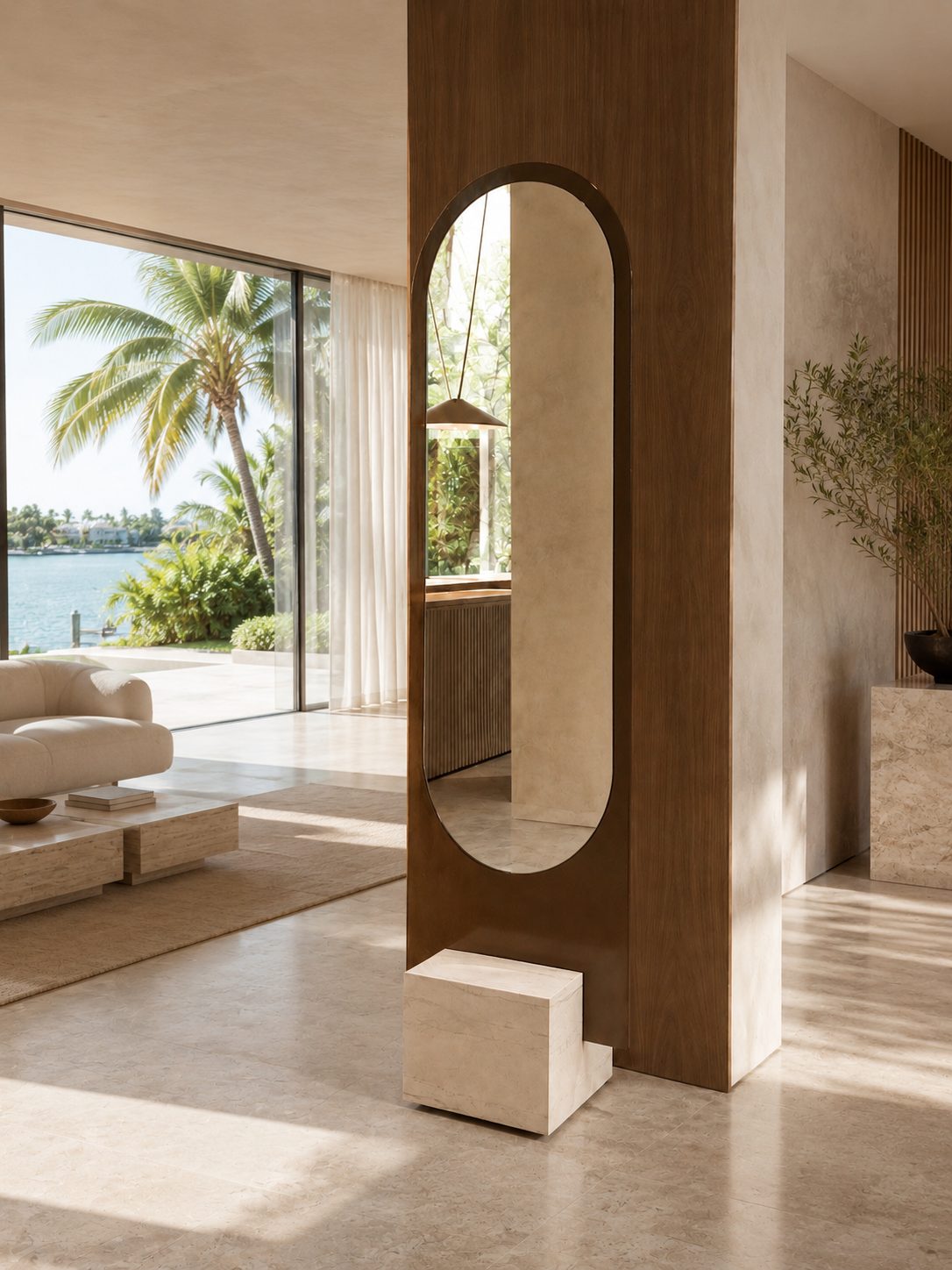
Some pieces stop reading as furniture the moment they enter a room. You walk in, and instead of checking your reflection, you circle the thing. That is the reaction we keep coming back to with Alice, a floor piece from Toronto studio Claris Company built with Cosentino’s ĒCLOS mineral surface. It reads less like a fixture and more like the kind of sculptural mirror coastal rooms in Naples have always had space for: an object that holds its own in a light-filled foyer, catches the afternoon in a dressing room, and gives a powder room a reason to slow down.
We came across Alice through a piece Cosentino published on how ĒCLOS became part of the design, and it stayed with us because it lines up with something we see in coastal-contemporary homes here. Our best interiors are material-rich and full of daylight. They reward objects that change through the day rather than sit still. Alice is one of those objects, and the story of how it came together says a lot about why it works on this coastline.
The Sculptural Mirror Coastal Homes Have Been Missing
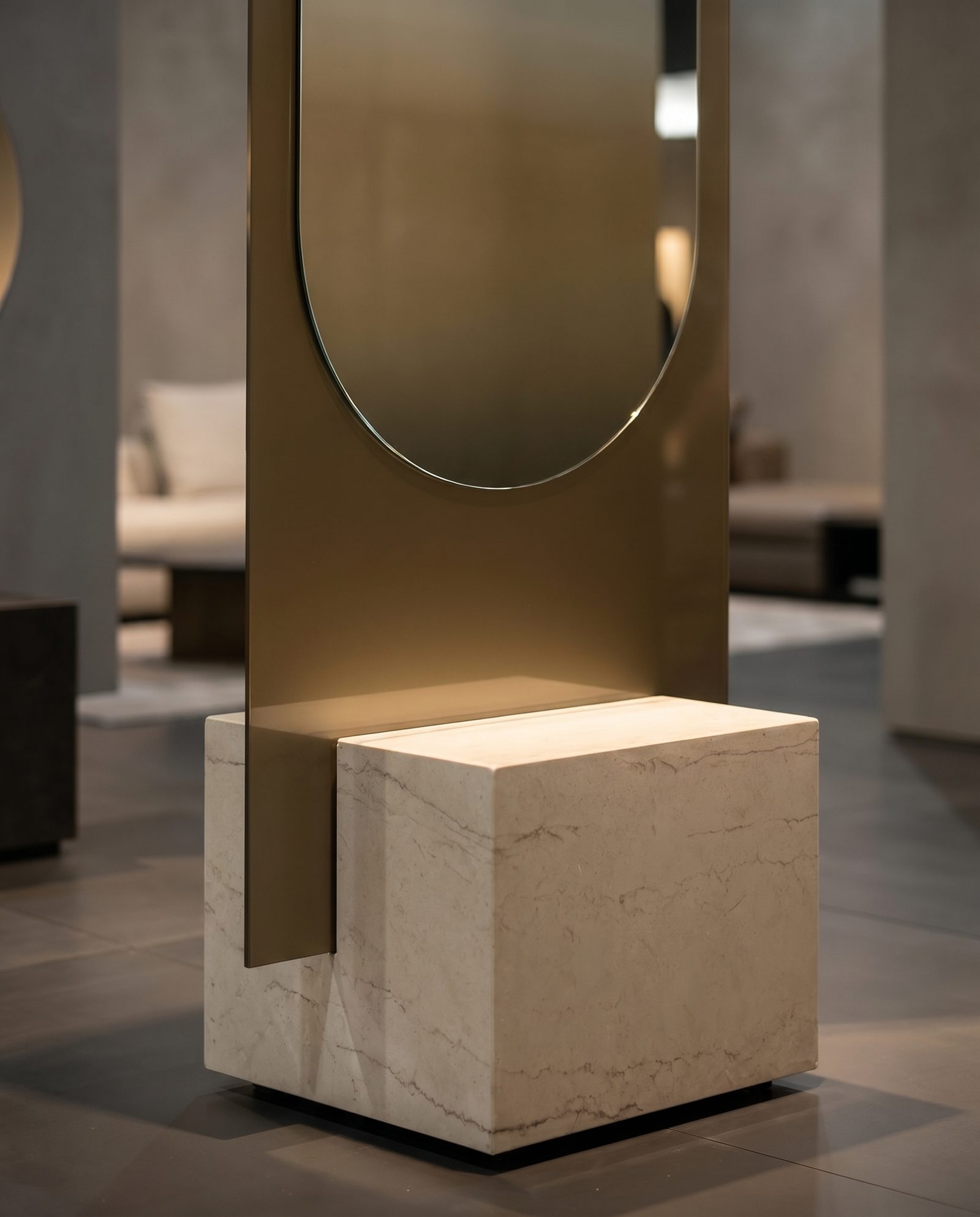
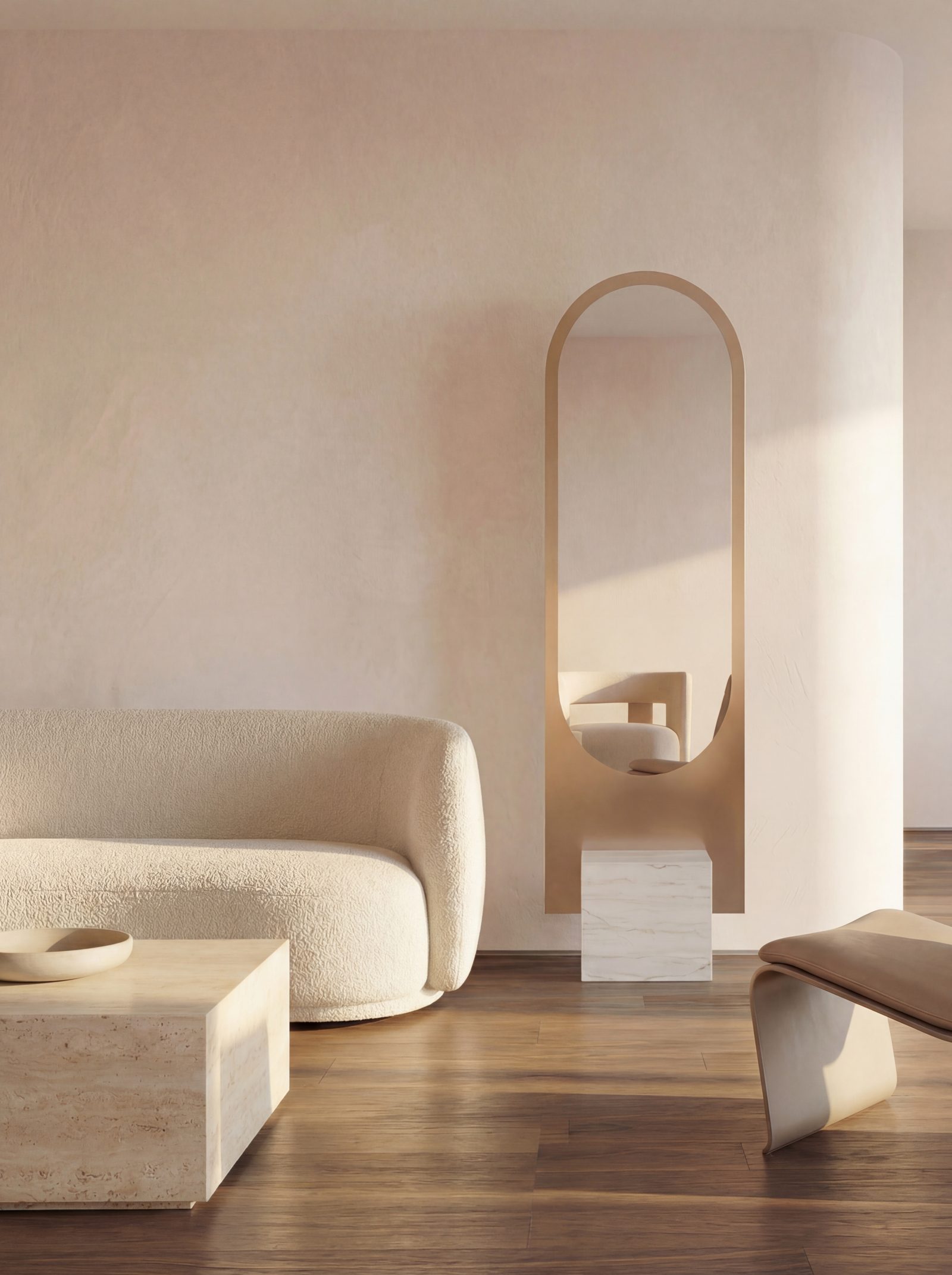
Alice is a freestanding floor sculpture that pairs bronze-frosted Belgian glass with a base made from ĒCLOS. According to Cosentino, it changes as light, movement, and perspective shift through the day, which is exactly why it suits rooms with strong natural light. In a Naples home, that is most of them. Morning light off the Gulf is different from the flat white of noon, which is different again from the warm wash before sunset. A piece that answers all three earns its place near a window.
The bronze-frosted glass is the part that makes it feel coastal rather than cold. It carries warmth instead of the hard silver of a standard mirror, so it flatters the sandy neutrals, rattan, and pale woods that show up in so many of our interiors. Set it against a white plaster wall and it softens the whole corner. Set it near travertine or a linen sofa and it belongs. If you are already thinking about how calm, warm materials shape a bedroom, our notes on coastal bedroom ideas cover the same instinct from a different angle.
Why ĒCLOS Changes the Conversation
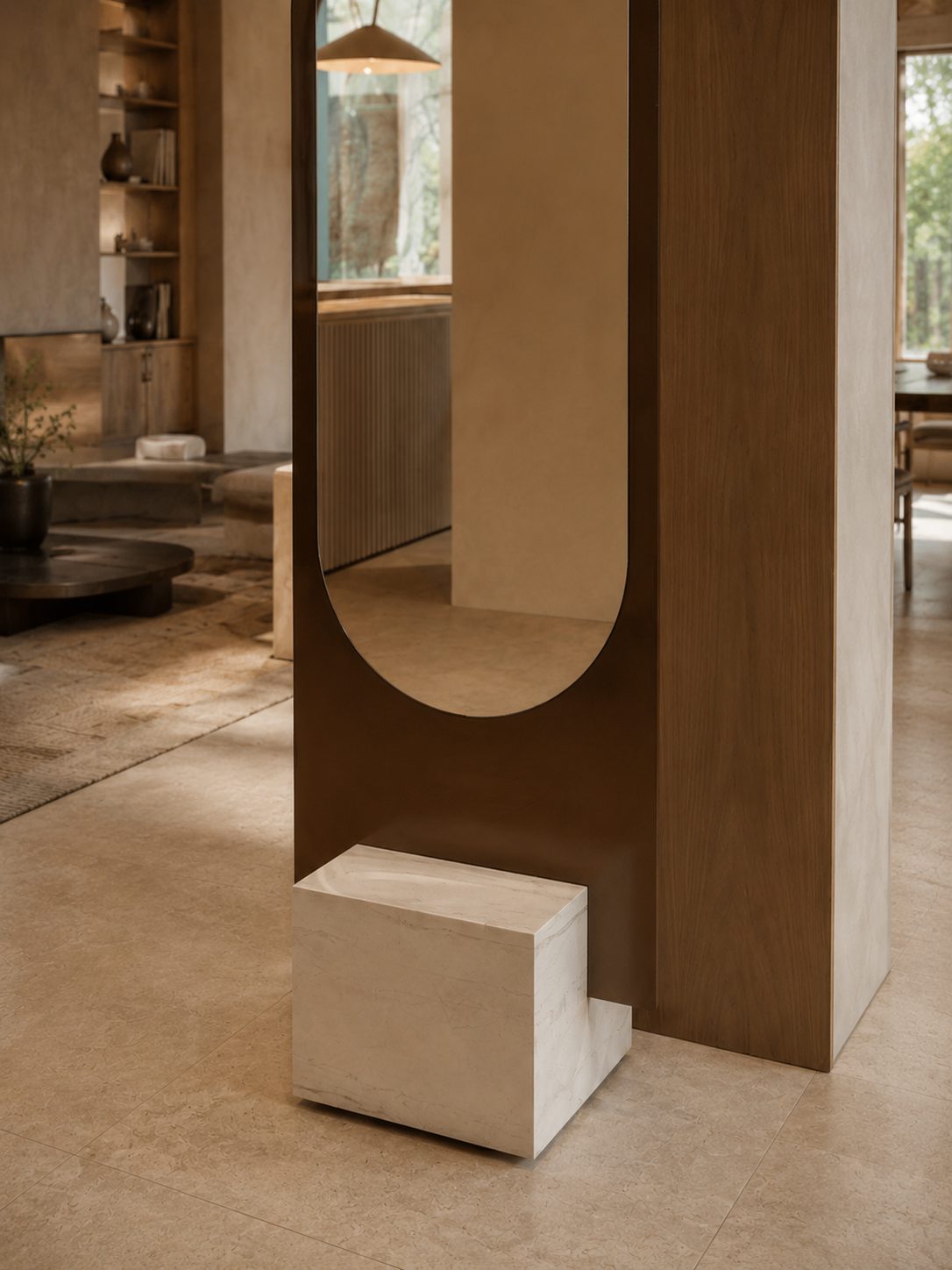
The base is what turns a good mirror into a sculpture. ĒCLOS is a full-body mineral surface with continuous veining, developed by Cosentino for architecture. The phrase to hold onto is full-body. The same natural character reads across every edge and profile, so the material can be shaped and exposed from any angle without losing its visual integrity. There is no thin decorative face hiding a plain core. Cut it, turn it, stand it in the middle of a room, and it stays believable from all sides.
That matters for a floor piece more than for a countertop. A counter is seen from above and one side. A sculpture is seen in the round. You walk past it, you catch it from the hallway, you notice it from the sofa. A surface that only looks resolved from the front would give itself away. ĒCLOS does not. For coastal interiors where stone, shell, and mineral textures already do a lot of the talking, a mirror built on genuine mineral surface reads as part of the family rather than an afterthought.
How Alice Came Together
The origin story, as Cosentino tells it, is a slow one, which we like. Claris founder Eugene Ishchak met the studio’s Creative Director, Benoit Gerard, at Cosentino’s C·NEXT event. The dialogue continued at Cosentino City Toronto around an earlier mirror concept called Twins, which became the creative language of what is now the Gemini Collection. At C·NEXT 2026, the two encountered ĒCLOS, and the material found its place in Alice and its smaller sibling, Alice Mini.
What we find worth repeating is how Gerard frames the intent. This was not about adding another mirror to a catalogue. It was about balance between the glass and the stone, where neither part is decoration for the other.
The idea was never simply to create another mirror. It was to create an object where every material contributes equally to the overall composition.
That is the difference between a mirror with a nice frame and a piece of sculpture that happens to reflect. In a room where the materials are already the point, the second kind is the one that holds up.
Two Scales, Two Finishes
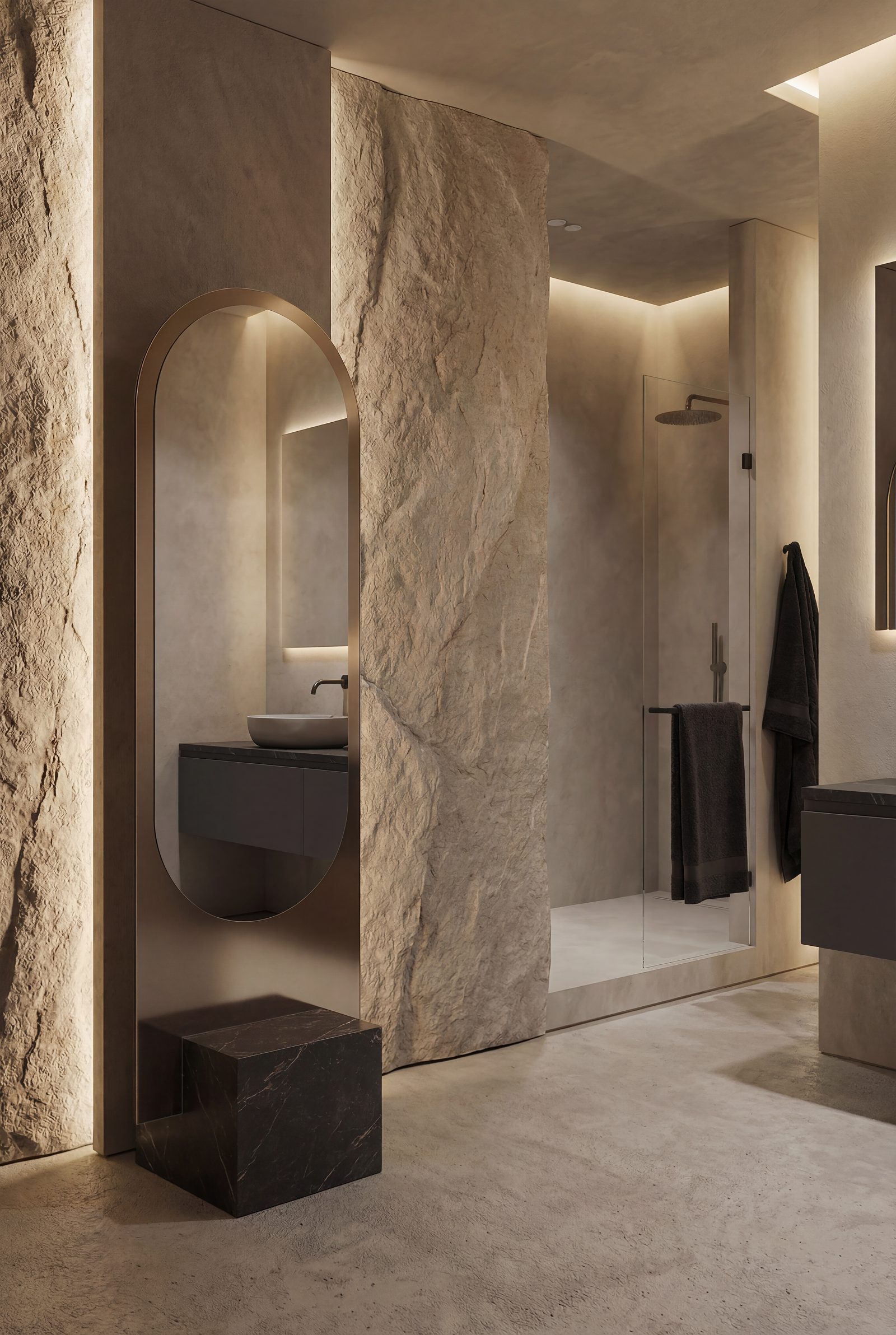
Alice comes in two sizes. The full Alice is the floor piece, sized to anchor a foyer, a dressing room, or a wide landing. Alice Mini brings the same language to tabletop scale, made for countertops, shelving, and vanities. In a powder room, the Mini sits on the counter and does the work of a styled object and a mirror at once. In a primary dressing area, the full piece leans into a corner and gives the room a focal point that is not a piece of art on the wall.
Both come in two ĒCLOS finishes. Ivora is a warm off-white matte that disappears into pale coastal palettes and lets the bronze glass carry the contrast. Phantome is a deep matte black, the choice when you want the piece to read as a shadow against a light wall, closer to how a bronze or dark-metal accent grounds a bright room. For anyone weighing where a statement object should live in a coastal home, the same logic that governs an indoor-outdoor space applies. Our breakdown of a lanai renovation in Collier County is a reminder that light and material decide almost everything on this coast.
Where It Sits in the Gemini Collection
Alice belongs to the Gemini Collection, nine mirrors designed by Gerard. Each pairs a primary form with a circular aperture, and all use 6mm bronze-frosted Belgian glass. Cosentino notes the pieces are crafted in Europe with Diamond ClearVision low-iron glass, certified to North American standards, and backed by a five-year warranty. The low-iron glass is the technical reason the reflection stays true rather than tipping green, which is what keeps warm coastal tones warm.
The range gives you room to scale the idea. Alice sits at the top at $5,000, with Alice Mini the accessible entry at $750. Between them sit pieces like Gigi (from $1,350), Alhena (from $1,700), Twins (from $1,800), Leda (from $1,900), Jumeau (from $2,000), Mercure (from $2,400), and Vivo (from $2,550). For a Naples project, that spread means a single design language can run from a powder room accent to a foyer statement without changing vocabulary.
The Takeaway for Coastal Interiors
What draws us to Alice is not novelty. It is fit. A material-rich, daylight-heavy home wants objects that behave like objects, that change with the hour and hold up from every angle. A mineral base with continuous veining and a warm bronze reflection does both. If you are the kind of reader who tracks down the pieces before the crowd does, it is worth knowing where the design-forward showrooms and sources sit, which is a running theme in our guide to the Naples Design District showrooms. Alice is a good example of the shift we keep noticing: the mirror is no longer the last thing you hang. Sometimes it is the first thing you build the room around.
Sources
- Cosentino, “How ĒCLOS Became an Integral Part of Alice and Alice Mini,” cosentino.com
- Claris Company, Gemini Collection, clariscompany.com